
Legal Guide | BP-00
The Layers of Israeli Property Law: How and Why of Israeli Property Law
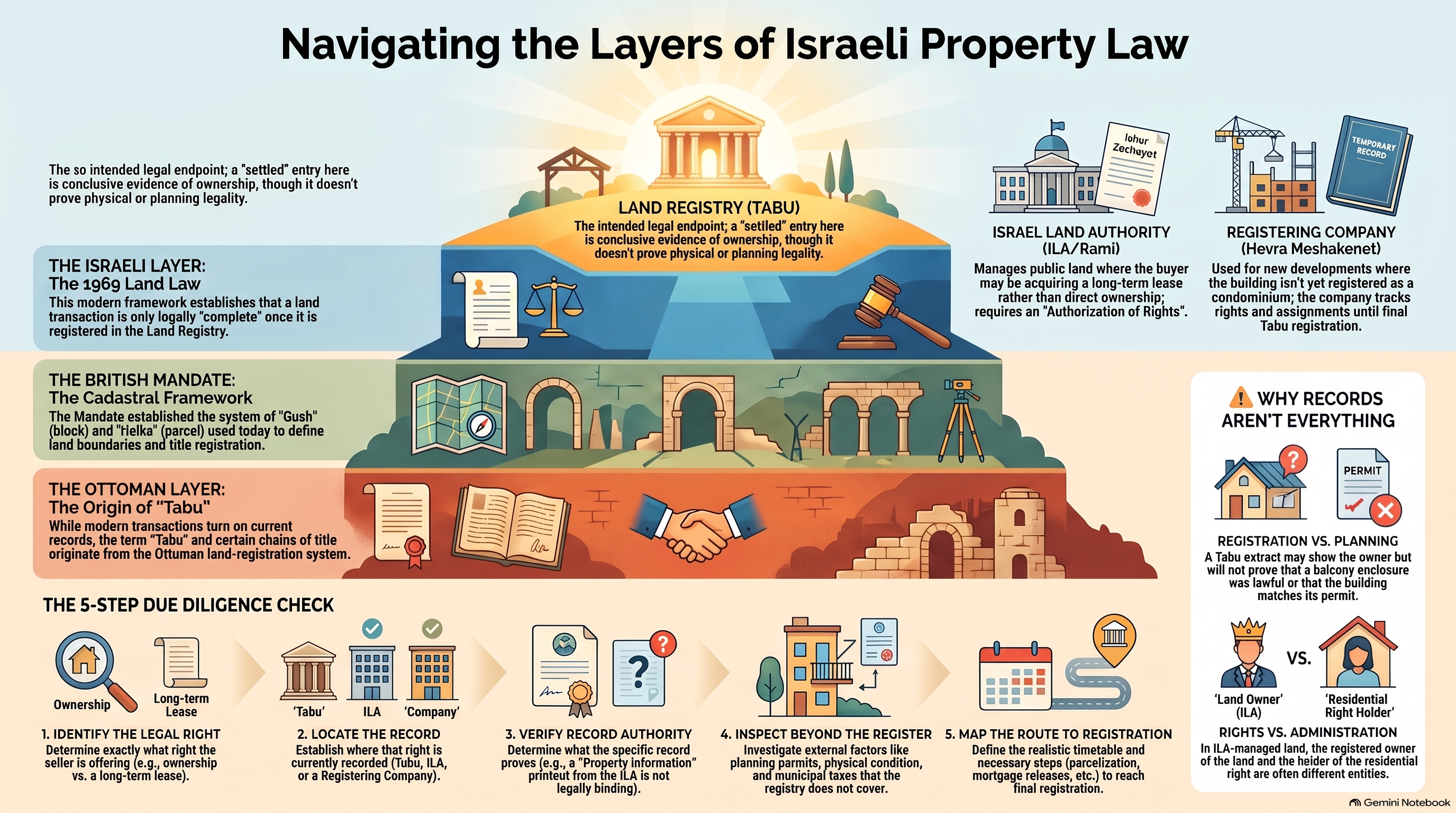
Why the process can feel unfamiliar
For many buyers, purchasing property in Israel can feel unnecessarily complicated. Why are payments usually made in stages rather than all at once? Why can completion take time? Why do different professionals sometimes answer different parts of the same question?
The answer is not simply that the system is slow. Israeli property transactions operate through several legal and administrative layers. Each record answers a particular question, and no single document proves everything a buyer needs to know.
The short answer
A property may be registered in the Land Registry, commonly called the Tabu (טאבו); administered by the Israel Land Authority, or ILA (רשות מקרקעי ישראל, רמ״י); or, while a development is still being registered, tracked through a registering company (חברה משכנת). These systems can overlap, but their records are not interchangeable.
Before a buyer commits, the lawyer must identify the precise right being sold, establish where that right is currently recorded, and determine both what the relevant record proves and what it does not. A Tabu extract may be examined near the beginning of due diligence, while registration of the buyer's rights is generally the intended legal endpoint after the contract, staged payments, taxes, financing, municipal documentation and mortgage releases have been addressed.13
Why history still affects a purchase today
Israel did not begin with a blank land register. Ottoman, British Mandate and later Israeli institutions created records for different purposes. Settlement and surveying proceeded over time, and some housing projects were occupied or sold before every registration stage was complete.
A buyer does not need to become a legal historian. The practical consequence is that a lawyer cannot safely assume that every apartment is represented by the same kind of record.
The investigation therefore begins with five questions:
- What legal right is the seller offering?
- Where is that right recorded now?
- What does that record establish?
- What remains outside that record, including planning legality, physical condition, tax and authority to transfer?
- What must happen before the buyer can be registered?
The Ottoman layer: records and the language of Tabu
Property and tax records from the Ottoman period remain relevant in some chains of title. The everyday term Tabu is associated with the Ottoman land-registration system, but an ordinary apartment purchase generally turns on current records, the seller's chain of rights, and present planning and transaction documents.
Older records become especially important when the current chain is incomplete, land was never fully settled, a boundary or first-registration issue arises, or the property lies in an area with a distinct legal history. Jordanian-era records may also matter in particular locations. The competent authority and applicable law must be identified for the property itself.
The British Mandate layer: survey, settlement, blocks and parcels
The British Mandate developed the modern cadastral system used for title registration. A cadastre is the surveyed framework that divides land into registration blocks and parcels, known in Hebrew as gush (גוש) and helka (חלקה). Survey of Israel materials describe the modern cadastre as originating under the Mandate and being based on title-registration principles.78
That system connected two distinct tasks:
- the technical task of surveying and defining parcels; and
- the legal task of investigating, settling and registering rights in those parcels.
The distinction remains important. An online map can help locate a property, but it is not automatically the binding ownership record and does not prove that construction was permitted. Where a boundary matters, a licensed surveyor may be required. Where the question is whether the apartment matches its permit and approved plans, an architect or another appropriate professional may be required.
The Israeli statutory layer: registration has legal consequences
The Land Law, 5729-1969 (חוק המקרקעין, תשכ״ט-1969), and the Land Rights Settlement Ordinance [New Version], 5729-1969 (פקודת הסדר זכויות במקרקעין [נוסח חדש], תשכ״ט-1969), form the central modern framework.12
Section 7 of the Land Law provides that a land transaction requiring registration is completed by registration; until then, it is treated as an obligation to complete a transaction. Registration is therefore not merely an administrative receipt. It is the legal step that completes the transfer of the proprietary right.1
The register also has important evidentiary consequences. Under section 125, an entry concerning settled land is conclusive evidence of its contents, subject to the specific correction mechanisms preserved by the Settlement Ordinance. For unsettled land, the entry is prima facie evidence. Sections 9 and 10 address competing transactions and good-faith reliance on the register.12
A current Tabu extract may show owners, leases, mortgages, cautionary notes, easements, attachments, court orders and other restrictions.3 It does not, by itself, prove that the apartment as built matches its permit, that an enclosed balcony is lawful, or that the property is physically sound. Those questions require separate records and, where appropriate, separate professionals.
The public-land layer: ownership and administration are different questions
Land administered by the ILA creates a distinction that can surprise an overseas buyer. The registered owner and the residential right being transferred are not always the same thing. The buyer may be acquiring a long-term lease or another administered interest and may need to examine both the Land Registry and ILA records.
For an eligible property, the ILA can issue an authorization of rights (אישור זכויות). For property also managed by a registering company or housing entity, the ILA may instead issue a notice that is not a legally binding authorization of rights.4 An ILA information printout is different again: the ILA expressly states that it is not proof of its contents and cannot be treated as legally binding.5
The label therefore matters. A Tabu extract, ILA authorization of rights, ILA information printout and registering-company certificate do not have the same legal effect.
The registering-company layer: an apartment may exist before its final Tabu entry
In a new development, registration work may continue after construction and even after buyers take possession. The land may require parcelization (פרצלציה), the building may need to be registered as a condominium (בית משותף), and each apartment must ultimately be identified as a separate subparcel (תת-חלקה). Only then can the individual buyer's rights be registered in the ordinary form.6
Until those steps are complete, a developer or registering company may maintain records of purchasers, mortgages, assignments and other commitments. The buyer may already possess and live in the apartment while its independent Tabu entry is still pending.
That does not make the rights imaginary. It changes the investigation. The lawyer may need the registering company's certificate, the complete chain of agreements and assignments, mortgage documents, ILA material and evidence of the project's registration status. The contract must address the real route to transfer rather than assume that a standard Tabu deed can be registered immediately.
What the buyer should recognize
The layered system may be relevant when:
- the seller produces an ILA or registering-company certificate instead of an individual Tabu extract;
- the Tabu extract identifies a larger parcel but not the apartment as a separate subparcel;
- the seller is not yet shown as the registered owner;
- the project is still undergoing parcelization or condominium registration;
- the documents refer to a long-term lease, ILA requirements or a chain of assignments; or
- the address, physical apartment and registered identifiers do not align clearly.
None of these facts automatically makes a purchase defective. Each changes what must be obtained, verified, promised in the agreement and completed before money is released or final registration is attempted.
What must be resolved before signing
Before commitment, the legal review should establish:
- the precise right being sold and the current rights holder's authority to sell;
- every operative record and material encumbrance;
- whether the apartment is already an independent registered unit;
- the documents and institutional approvals required for transfer;
- the separate planning and physical checks required; and
- the realistic route and timetable to final registration.
The practical lesson is not merely to ask, “Is there a Tabu?” The better questions are: What right exists? Where is it recorded now? What does that record not establish? What remains necessary to make the buyer the registered rights holder?
Sources
- Land Law, 5729-1969 — current consolidated Hebrew text (Nevo)
- Land Rights Settlement Ordinance [New Version], 5729-1969 — current consolidated Hebrew text (Nevo)
- Generation of a Land Registry Extract, Ministry of Justice
- Authorization of Rights, Israel Land Authority
- Property Information, Israel Land Authority
- Registration or Update of Rights in the Land Registry, Israel Land Authority
- Cadastre, Survey of Israel
- Implementation of Legal Digital Cadastre in Israel, Gershon Steinberg, Survey of Israel
Information on this page is provided for general informational purposes only and does not constitute legal advice. Use of this website does not create an attorney-client relationship.